



Filling Machine
HG Machinery is one of the professional filling machine manufacturers in China. Welcome to buy filling machine for sale at competitive price here. Be free to check price with us!
Reasonable choice of filling machine is an important way to ensure the quality of beer production and improve economic efficiency. The products we provide have the advantages of good quality, high efficiency, simple structure, convenient use and maintenance, small size and light weight.
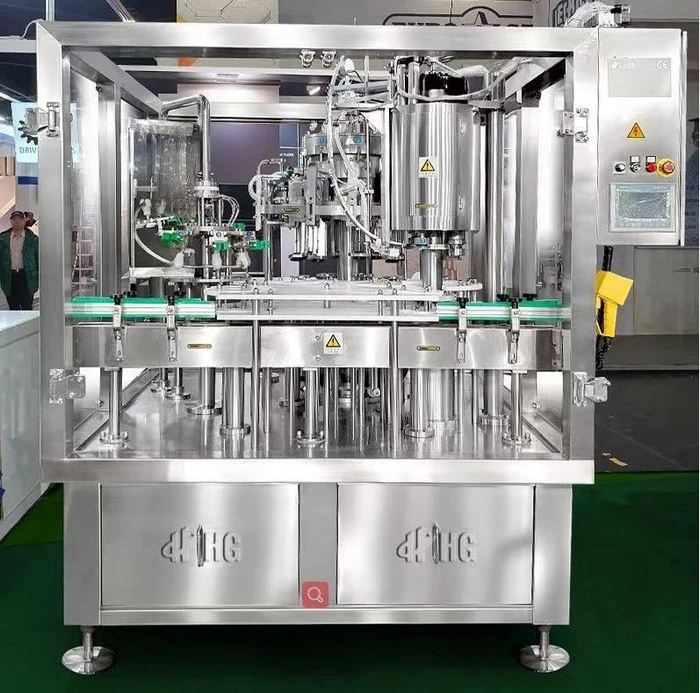
The filling machine is a fully automatic high-precision filling equipment. It is a series of special equipment for aseptic filling production line. It is mainly used for the production of various beer filling lines. The filling machine is a three-in-one filling production line, which realizes rinsing and filling on one machine. The cover is fully automatic filling production, which shortens the contact time between materials and the outside world, and improves sanitary conditions, production capacity and economic benefits.
Features:
● Precise filling, good sealing performance, no liquid loss, adjustable torque, suitable for a variety of caps.
● The filling valve adopts high-precision mechanical filling valve, which has a bottle-free and vacuum-free mechanism.
● External mechanical valve structure, no spring and seal in the valve body.
● It has two vacuuming capabilities and is equipped with a high pressure foaming device.
● The drive uses an open gear and gearbox combination drive.
● The frequency conversion stepless speed regulation is adopted, and the speed regulation range is large.
● The transmission of this filling machine is equipped with grease automatic lubrication device, which can be used to supply oil to each lubrication point regularly. High transmission efficiency, low noise and long life.
● In the case of airing or pouring, the bottle is automatically closed due to the quality of the bottle, and the automatic bottle washing device is equipped.
● All stainless steel magnetic hopper is used. The cover and lower cover are both transmitted by magnetic force. The cover is not easy to be deformed during operation.
● The cover is reliable and has automatic unloading function, which reduces the bottle breaking rate.
● The centering guide adopts double guide type alignment and has a pre-cover function. The bottle is stable and reliable.
● The lifting and lowering of the wine cylinder and the gland head are electric lifting to meet the bottle height of different heights within the design range.
● The liquid level of the material in the filling machine is controlled by the electric probe, the cylinder liquid level is stable, and the filling is reliable.
What Is Filling Machine
A filling machine is a type of equipment used in manufacturing and packaging processes to fill containers with various substances, such as liquids, powders, and granules. The machine is designed to precisely measure and dispense a predetermined amount of the product into each container, ensuring uniformity and accuracy in filling. The filling machine can be used in a variety of industries, including food and beverage, pharmaceuticals, cosmetics, and chemical manufacturing. Some examples of filling machines include piston fillers, gravity fillers, and volumetric fillers.


Benefits of Filling Machine
Increased speed and efficiency
Filling machines can fill containers much faster than manual filling processes, thereby increasing production rates and reducing labor costs.Filling machines can ensure more accurate and consistent filling levels.
Reduced product waste
Filling machines are accurate, meaning they ensure precise measurements of products are dispensed into containers, leading to less product waste.
Improved product quality
Filling machines eliminate the variation in product volumes, resulting in uniform quality of the filled products.Filling machines also reduce the risk of contamination and improve the overall quality of the product.
Reduced physical strain
Filling machines handle the physical aspect of filling operations, reducing physical strain on workers.This is especially beneficial for industries that handle large quantities of product, as manually filling each container can be physically demanding and can lead to injuries and health problems for workers.
Enhanced flexibility
Filling machines are capable of filling various sizes and shapes of containers.Additionally, flexible filling machines can handle a wide range of products, from liquids and powders to viscous substances and semi-solids, further increasing their versatility.
Automation
Automatic filling machines do not require human intervention, making them cost-effective and more efficient.Automation in filling machines is a valuable investment for companies looking to increase productivity and reduce costs.
Why Choose Us
High quality
Our products are manufactured or executed to very high standards, using the finest materials and manufacturing processes.


Quality control
We have built a professional QC team to accurately inspect every raw material and every process of production.
Professional team
Our professional team collaborate and communicate effectively with one another, and are committed to delivering high-quality results. They are capable of handling complex challenges and projects that require their specialized expertise and experience.


One-stop solution
We can offer a range of services, from consultation and advice to product design and delivery. It is a convenience for the customers, as they can get all the help they need in one place.
Customized services
We understand that each customer has unique manufacturing needs. That’s why we offer customization options to cater to your specific requirements.


24H online service
We try and respond to all concerns within 24 hours and our teams are always at your disposal in case of any emergencies.
Types of Filling Machine
Gravity filling machine
This is the most common type of filling machine that uses gravity to fill containers with liquid products. The liquid flows down into the container from a tank or source above.
Vacuum filling machine
This type of filling machine is used for filling containers with liquids that are thick or viscous. The container is held at a vacuum, and the liquid is sucked into the container using a vacuum pump.
Piston filling machine
This type of filling machine uses a piston that moves up and down to fill containers with liquid products. The piston is controlled by a system of camshafts and gears, which allow for precise filling of containers.
Overflow filling machine
This type of filling machine is used for filling containers with liquids that are prone to foaming. The liquid is overflowing from the container, and the excess is collected in a reservoir.
Net weight filling machine
This type of filling machine weighs the product as it is dispensed into the container. A computer-controlled system regulates the flow of product to ensure that the correct weight is achieved.
Pressure filling machine
This type of filling machine uses pressure to fill containers with liquid products. The liquid is pumped into the container under pressure, which helps to create a tight seal.

Stainless steel
This is a popular material for filling machines as it is durable, corrosion-resistant, and easy to clean.
Aluminum
This material is lightweight and has good thermal conductivity, which makes it suitable for machines used for filling hot liquids.
Plastic
Filling machines used for filling liquids such as water, juice, and milk can be made from food-grade plastic materials such as HDPE, LDPE, and PET.
Glass
Some filling machines are made from glass containers for filling products such as oils and perfumes.
Brass
This material is used for filling machines used for filling thick and viscous products such as honey and jam, as it is durable and resistant to corrosion.
Application of Filling Machine
Food and beverage industry
Filling machines are used for filling bottles, jars, cans, and other containers with a wide range of food and beverage products, including soft drinks, energy drinks, juices, water, beer, wine, spirits, sauces, condiments, and more.
Pharmaceutical industry
Filling machines are used for filling ampoules, vials, syringes, and other containers with various pharmaceutical products, including liquid medicines, injections, and vaccines.
Cosmetic industry
Filling machines are used for filling tubes, jars, and bottles with lotions, creams, oils, shampoos, perfumes, and other cosmetic products.
Chemical industry
Filling machines are used for filling bottles, drums, and other containers with different chemicals, including cleaning agents, lubricants, solvents, and other industrial products.
Petroleum industry
Filling machines are used for filling tanks and containers with various petroleum-based products, including gasoline, diesel, and oil.
Paint industry
Filling machines are used for filling cans and containers with different types of paints, including water-based paints, oil-based paints, and other coatings.
Process of Filling Machine
Preparation
The first step is to prepare the machine by ensuring that it is clean and free from any dust or debris that could contaminate the product.
Product transfer
The product is transferred to the hopper or container which is connected to the filling machine. The product can be transferred manually or automatically depending on the type of filling machine.
Filling process
The filling process starts when the container is placed underneath the filling head. The filling head is then lowered onto the container and the product is pumped into it. The filling speed and volume can be adjusted as required.
Leveling
A leveling device is used to ensure that there is an even level of the product inside the container.
Capping
Once the filling process is complete, the container is moved to the capping station where a cap or lid is fitted over the container.
Packaging
Finally, the filled and labeled containers are packaged into boxes or other suitable containers for storage or transportation.
Components of Filling Machine
Filling nozzles
The filling nozzles are responsible for dispensing the material into the containers. They come in different shapes and sizes to match the shape and size of the containers.
Hopper or container
The hopper or container holds the material that needs to be filled in the containers.
Control panel
The control panel is the brain of the filling machine. It controls the entire process of filling, from setting the amount of material to be dispensed to regulating the speed of the machine.
Conveyors
Conveyors are used to transport containers from one station to another. They come in different forms, such as belt conveyors, roller conveyors, or motorized conveyors.
Sensors
Sensors are used to detect the presence of containers and to control the filling process. They can detect empty containers and automatically stop the machine when the filling level is reached.
Pumps
Pumps are used to move the material from the hopper to the filling nozzles. Different types of pumps are used depending on the viscosity and flow characteristics of the material being filled.
Valves
Valves are used to regulate the flow of material from the hopper to the filling nozzles. Different types of valves are used depending on the type of material being filled.
Capping or sealing machine
After the containers are filled, they need to be capped or sealed to close them securely. Capping or sealing machines are often combined with filling machines to create complete packaging lines.
Maintenance Tips for Filling Machine

Regular cleaning
Clean the machine and its parts daily, weekly, or monthly, depending on the usage. Use cleaning solutions recommended by the manufacturer to prevent damage to the machine.
Training
Train the operators on the correct use of the filling machine and its maintenance procedures. Proper use and maintenance will prolong the machine's life and reduce downtime.

Inspection
Inspect the machine regularly for loose screws, damaged belts, worn out parts, and leaks. Replace or repair damaged parts immediately.

Calibration
Calibrate the machine regularly to ensure accuracy in filling volume. Follow the manufacturer's instructions for calibration.
What Factors Should Be Considered When Selecting a Filling Machine
Capacity
Determine the filling capacity you require based on your expected production volume. Look for filling machines that can handle the number of bottles or cans you plan to fill per hour, ensuring that the machine can keep up with your output.
Accuracy
The filling machine should be able to fill the bottles or cans accurately, without overfilling or underfilling. Accuracy is essential to maintain the quality and consistency of your beer. Look for machines with precision filling mechanisms and controls.
Ease of use
The filling machine should be easy to operate and maintain. It should have clear instructions and be straightforward to set up and adjust. Additionally, it should have easy access for cleaning and sanitizing to ensure cleanliness and hygiene.
Durability
The filling machine should be built with high-quality materials and components to ensure longevity and durability. It should be able to handle the rigorous demands of continuous use in a brewery environment.
Cost
Determine your budget for the filling machine and look for machines that offer good value for the price. Compare different models and features to find one that meets your needs within your budget.
Customer support
Ensure that the manufacturer or supplier offers good customer support and after-sales service. This will be important for installation, training, and any future maintenance or repairs.
Filling machines are commonly used in industrial settings to quickly and efficiently fill containers with liquids or powders. However, if not properly operated and maintained, filling machines can pose significant safety risks. Only allow trained and authorized personnel to operate the filling machine. Ensure all operators receive proper training on how to use the machine safely and what to do in case of an emergency. Review safety procedures regularly. Operators should always wear the proper PPE when using a filling machine, which may include gloves, steel-toed boots, safety glasses, hearing protection, and other equipment depending on the materials being handled. PPE protects against risks like spills, splashes, and falling or ejected contents. All moving parts and areas with pinch points should be guarded to prevent accidental contact. Inlet and outlet parts should have covers to contain spills and overflows. Guards and covers should remain in place at all times during operation for maximum protection. Establish clear procedures for safely shutting off and locking out the filling machine in case of issues, spills, clogs or before any cleaning, maintenance or adjustment. This prevents accidental startups that could cause injury. Ensure proper calibration and functioning of volume and weight controls to prevent overfilling. Overfilling risks spills, splashes and ejected materials which pose safety and cleaning issues. Regularly inspect and test fill controls. Carefully handle and transport any materials, such as powder, that pose inhalation or dust explosion risks. Use proper ventilation and contain all dust, vapors and fumes. Have appropriate spill containment, cleanup tools and procedures in place to quickly address any spills or leaks from the machine or materials. Spills pose slipping hazards and health risks if not promptly addressed. Schedule routine maintenance and inspection of the filling machine. Check for signs of wear, leaks or other issues. Promptly repair or replace worn parts to ensure continued safe operation. Keep records of all inspections. Post clear procedures for responding to emergency situations like fires, chemical spills, injuries or machine malfunctions. Ensure operators are trained on emergency procedures.
What Is the Output Rate of the Filling Machine
The output rate of a filling machine refers to how quickly it can fill containers with a product. The rate is measured in containers filled per minute or hour. The output rate depends on several factors related to the filling machine design and operation. One of the primary factors is the type of filling process. Some common filling processes include volumetric, piston-based, rotary wheel, auger, and vacuum methods. Volumetric filling utilizes precision meters that dispense exact volumes of product into containers moving on a conveyor belt. Piston fillers use pistons to push product into containers. Rotary fillers work with awheel that rotates containers into filling stations. Auger fillers screw or push product into containers. Vacuum fillers draw product into containers held under vacuum. Faster processes like rotary or volumetric filling generally have higher output rates. The design speed of the filling machine also influences the output rate. Most can operate continuously at their rated filling speeds but may also offer variable speeds for flexibility. Higher rated filling speeds allow for more containers to be processed per unit of time. Operating at the maximum filling speed achieves the rated output capacity. The container type being filled is another factor. Small jars, bottles or cartons are generally faster to fill than bulkier bags or boxes. Liquid products also fill faster than thicker viscous materials. The container size, shape, opening size and material all play a role in fill time and output rate. Product properties like viscosity, density and flow characteristics impact the fill time directly. Thicker syrups or pastes take longer to dispense than water-like liquids. Heavier products also require more filling force than lighter ones. Formulations need to allow for sufficient fill speed without product separation or defects. Downtime for changeovers between product types, container sizes or batches reduces total output versus continuous operation. Automated or quick-change filling heads can minimize non-productive time compared to manual adjustments. Well-designed changeover procedures and components optimized for speed help maximize availability. Overall equipment uptime versus planned or unplanned stoppages affects output rate. High-quality filling machines have reliable components designed for maximum equipment effectiveness. Proper maintenance ensures components last longer between repairs. Careful process monitoring prevents jams and defects that cause downtime. Factors like personnel availability for operation also influence overall equipment output.
Prepare the filling machine
Before rinsing, ensure that all parts of the filling machine that will be exposed to the rinse water are clean and free of any debris or residue. This includes the bottle neck, bottle mouth, and filling head.
Rinse with clean water
Run clean water through the filling machine to remove any remaining beer or other residue. This helps to ensure that any remaining particles are removed before sanitizing.
Sanitize with sanitizer
Use a suitable sanitizer solution, such as bleach or peracetic acid, to sanitize the filling machine. Follow the manufacturer's instructions for the sanitizer solution and ensure that all parts of the machine are thoroughly sanitized.
Rinse with clean water again
After sanitizing, rinse the filling machine with clean water again to remove any remaining sanitizer solution. This helps to ensure that the machine is clean and free of any residue before use.
Dry the filling machine
After rinsing, dry the filling machine thoroughly to prevent any moisture or condensation from building up. This helps to maintain cleanliness and prevent the growth of bacteria or other microorganisms.
Inspect the filling machine
Finally, inspect the filling machine for any remaining debris or residue. If any foreign objects or residue are found, remove them and repeat the rinse process until the machine is clean.
Our factory
Shandong HG Machinery Co., Ltd is located in Jiyang District, Jinan, China. Shandong HG Machinery Co., Ltd. owns more than 10000 m2 workhouse and more than 20 experienced technicians


Certificate

FAQ